01 · UNDERSTAND
Start with your real question.
Work, relationships, uncertainty, success without meaning — begin wherever life feels unresolved.

Most advice was written for someone else. Sherpa listens and uses the Three Mountains map to work out where you are — in your work, your relationships, and what comes next. It helps you choose a step that fits and follows through with you.
When the next step is a person, it helps you understand the people you know — and find the ones you now need.
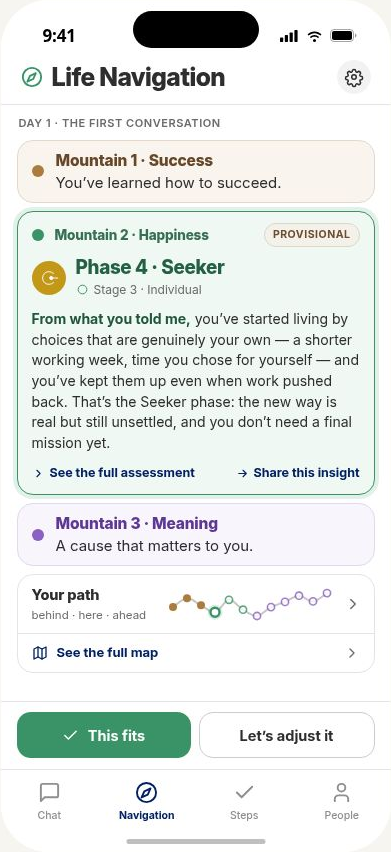
Three Mountains, first published in 2015, is a map of how adult life unfolds: first success, then happiness, then meaning. What helps on one mountain can hold you back on the next. Sherpa uses the map to work out where you are, what may be changing, and which step makes sense now — in plain words, as orientation, not verdict.
You can't skip the second mountain — and you can't live there.
The mountains show the journey. The stages and phases bring it into focus.
Meet John. Sherpa works out where he is on the map, then one question opens into a next step and a different conversation with the people he cares about.
3:33 · No sound needed · Seven chapters
John has achieved what he wanted. So why doesn't it feel right? Sherpa starts by listening.
The Three Mountains map helps Sherpa offer John a possible orientation — not a label or verdict.
John chooses what to share with Anna. His private conversation stays private.
With Anna's permission, they begin to see one another more clearly.
Sherpa helps John choose something doable and return to it when life gets complicated.
The demo illustrates introductions to people with relevant experience — with mutual choice.
With permission, Sherpa supports a difficult conversation without taking over the relationship.
Understanding is the start. The point is what you do with it.
Until recently an AI couldn't remember you or stay with you between conversations. Now it can — and Humania is built to turn that into real-life action.
Work, relationships, uncertainty, success without meaning — begin wherever life feels unresolved.
Turn perspective into one small action or commitment, in your words, sized for right now.
Return to what happened. If a step feels too big or life changes, reflect and adapt rather than just repeat the advice. Check-ins are your choice.
We'll measure Humania by steps taken in real life — not by minutes spent in the app.
ChatGPT can help you think things through. Humania is Google Maps for your life: it shows where you are, helps you navigate what comes next, and connects you with the people who matter.
Humania gives you an assessment on a map of adult life — Success, Happiness, Meaning — and says how sure it is. The same advice can free one person and trap another. The map tells which. A general assistant has no way to know.
An answer is a start. Sherpa helps you choose one step in your own words, checks in when you ask it to, and adapts when life changes. The measure isn't a good answer. It's a step taken in real life.
No chatbot can introduce you to someone who has been where you are. Humania can. Not "people you may know" — the person you need now, because everyone in Humania is on the same map. Both of you choose.
Can you paste the map into ChatGPT? Of course. It's been public since 2015. But a picture isn't navigation. Humania turns the map into an assessment — what evidence counts, what doesn't, and how certain it is — then into a step, follow-through, and a route toward real people.
ChatGPT gives you answers. Humania gives you a map, a next step, and the people who've been there.
It’s a better relationship with your life — and the people in it.
Humania begins with your own questions. We’re building a network around where you are in life — and the people who can help you move forward.
Share what Sherpa understood about you with someone close — a partner, a friend. They read it without an account; you choose what they see. Your conversation stays private.
Any AI can give advice. None can introduce you to someone who has been where you are.
Introductions with a reason to connect: a mentor who made a similar change, a friend facing the same question. Relevant experience, mutual choice — not just a profile.

Humania is built by István Joós, who has spent more than twenty years working with people at life's turning points. He first published the Three Mountains map in 2015 and has refined it through practice ever since. Humania brings that work into an app — and to the people around you.
He builds it with a team in Budapest — technology, operations and growth — including the engineers who have built Humania since its first version.
Founder & company ↗Humania is being built for iOS and Android, in English and Hungarian. Want to follow along? hello@humania.io
The app is in development for iOS and Android. App-store links and available countries will be confirmed closer to release.
Both languages are planned for the first app release. Public availability may differ by country and will be confirmed when distribution details are final.
The first release is planned to be free. Some services that involve another person may have paid options later; nothing is on sale here.
Sherpa gives you an assessment of where you are on the map and says how certain it is, in words. It’s an orientation you can question — not a rank and not a clinical diagnosis.
The first release focuses on you and the people you already know. Introductions to new people come after that, by mutual choice only.
Humania is being designed around user choice and consent. Specific storage, memory, sharing and deletion controls will be described in verified privacy documentation before the app launches.
Humania is not therapy, a diagnostic service or a substitute for qualified professional support.